The name Olivarrier holds its own starting point inside it: OLIVA and BARRIER. The skin-friendly lipids that come from the olive, and the thinnest, most consequential boundary — the place where skin meets the world.
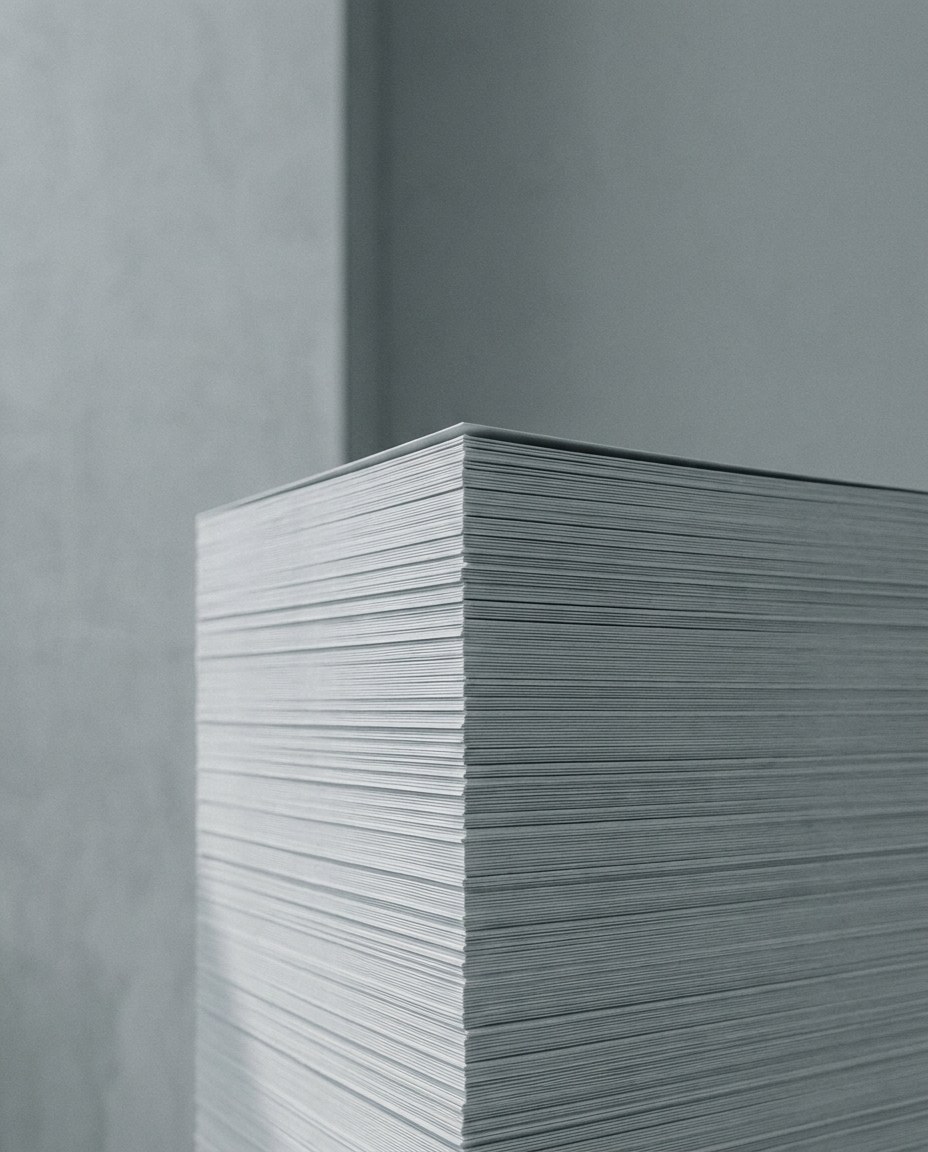
The skin barrier is not a wall built to keep everything out. It is closer to a selective border: it slows the water inside the body from leaving too quickly, and it limits what outside substances can come in. In the outermost stratum corneum, skin cells sit like bricks while the lipids between them — ceramides, cholesterol, free fatty acids — bridge the gaps, layer over layer. It is this thin architecture that lets us live outside of water at all.
The barrier is never finished and still. It shifts and settles again and again as it meets cleansing and friction, heat and humidity, sunlight. Transepidermal water loss is one of the standard ways to read its condition, but because the figure moves with temperature, humidity, airflow, and the site measured, no single reading speaks for the whole of the skin.
This is why we do not treat the skin barrier as one product's slogan. Gentle cleansing can ease needless strain; humectants can help the stratum corneum hold water; emollients and lipids can create conditions that slow the rate at which moisture leaves.
So at Olivarrier the barrier is not a line of ad copy — it is the standard by which a product is designed. What to leave on the skin after cleansing, and what combination will govern how water stays in the stratum corneum and how quickly it goes, we think through from the structure of the barrier outward. To begin at the barrier is to understand the skin's outermost boundary first, and then design the daily acts of cleansing and hydration around it.
References
- Elias PM. Stratum corneum defensive functions: an integrated view. J Invest Dermatol. 2005;125(2):183–200.
- Madison KC. Barrier function of the skin: "la raison d'être" of the epidermis. J Invest Dermatol. 2003;121(2):231–241.
- van Smeden J, Bouwstra JA. Stratum corneum lipids: their role for the skin barrier function in healthy subjects and atopic dermatitis patients. Philos Trans A Math Phys Eng Sci. 2016;374(2065):20150211.
- Alexander H, et al. Research techniques made simple: transepidermal water loss measurement as a research tool. J Invest Dermatol. 2018;138(11):2295–2300.


The name Olivarrier holds its own starting point inside it: OLIVA and BARRIER. The skin-friendly lipids that come from the olive, and the thinnest, most consequential boundary — the place where skin meets the world.
The skin barrier is not a wall built to keep everything out. It is closer to a selective border: it slows the water inside the body from leaving too quickly, and it limits what outside substances can come in. In the outermost stratum corneum, skin cells sit like bricks while the lipids between them — ceramides, cholesterol, free fatty acids — bridge the gaps, layer over layer. It is this thin architecture that lets us live outside of water at all.
The barrier is never finished and still. It shifts and settles again and again as it meets cleansing and friction, heat and humidity, sunlight. Transepidermal water loss is one of the standard ways to read its condition, but because the figure moves with temperature, humidity, airflow, and the site measured, no single reading speaks for the whole of the skin.
This is why we do not treat the skin barrier as one product's slogan. Gentle cleansing can ease needless strain; humectants can help the stratum corneum hold water; emollients and lipids can create conditions that slow the rate at which moisture leaves.
So at Olivarrier the barrier is not a line of ad copy — it is the standard by which a product is designed. What to leave on the skin after cleansing, and what combination will govern how water stays in the stratum corneum and how quickly it goes, we think through from the structure of the barrier outward. To begin at the barrier is to understand the skin's outermost boundary first, and then design the daily acts of cleansing and hydration around it.
References